Introduction to the hometown tax one-stop special exception system and special application form
English overview of the hometown tax one-stop special exception system, including eligibility, benefits, and filing steps.
- Supervised by セブンセンス税理士法人
- Certified public accountant and tax accountant: 大野 修平
- Hometown tax payment site: さとふる / Satofull
Introduction to the Hometown Tax One-Stop Special Exception System & Special Application Form
What is the One-Stop Special Exception System?
The One-Stop Special Exception System is a convenient mechanism that allows you to claim deductions for your Hometown Tax donations without filing a tax return.
You can use this system if you donate to five or fewer municipalities within a year.
Ordinarily, claiming donation deductions through the Hometown Tax program would require a tax return, but salaried employees who undergo year-end adjustments can still receive the deduction by utilizing the One-Stop Special Exception System.
To use the One-Stop Special Exception System, you must submit the required documents, including an application form, to each municipality you donated to within the specified application period. Once applied, the deduction will be automatically reflected in the residential tax from June of the following year, with no income tax deduction.
| Example of donating to 5 or fewer municipalities | Tax Deduction System | Steps Translation |
|---|---|---|
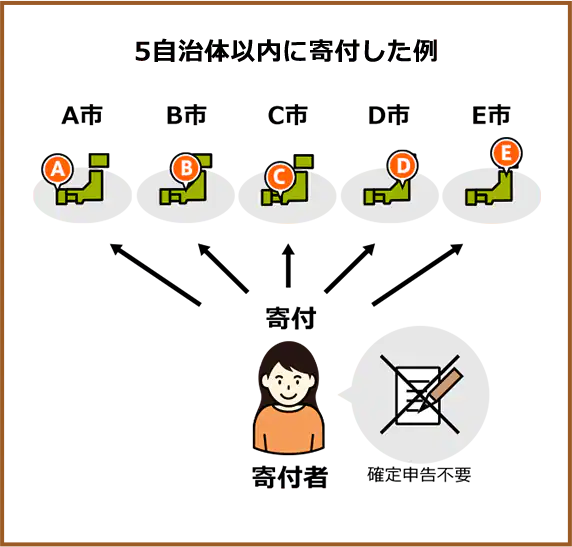 | 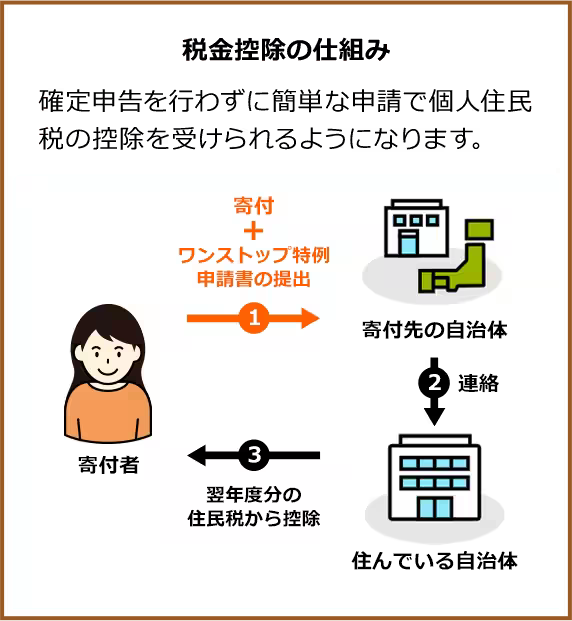 | [Donor] → (1) Donation + Submission of One-Stop Special Application Form → [Recipient Municipality] → (2) Notification → [Resident Municipality] → (3) Deduction from the following year's residential tax → [Donor] |
Benefits of the One-Stop Special Exception System
No need for a tax return to receive donation deductions
Salaried employees who undergo year-end adjustments can receive donation deductions without filing a tax return.Simple procedure
Complete the process by mailing the required documents to each municipality you donated to.
Eligibility Requirements for the One-Stop Special Exception System
The One-Stop Special Exception System is available if the following conditions are met:
- The applicant is a salaried worker who does not need to file an income or residential tax return.
- No other income or residential tax filings are required besides the Hometown Tax donation.
- Donations were made to five or fewer municipalities within the year.
In simpler terms, this system is available to those with no other tax filings outside of Hometown Tax donations. Most salaried employees will qualify without issue.
Note: Even if you donate more than five times, as long as the donations are made to five or fewer municipalities, you can use the One-Stop Special Exception System.
Based on regulations as of August 17, 2022; changes may occur due to future revisions.
Charitable donations made through organizations (e.g., the Japanese Red Cross Society) are not eligible for the One-Stop Special Exception System and require a tax return to claim deductions as a Hometown Tax.
Those filing a tax return cannot use the One-Stop Special Exception System.
⚠️ Important Points for the One-Stop Special Exception System
- Only applicable to residential tax deductions
- Note: When not exceeding the deduction limit for income tax, there is generally no difference in the total deduction between the One-Stop Special Exception System and tax returns.
- A separate One-Stop Special Application Form is required for each donation made
- Be mindful of the deadline for submitting the "One-Stop Special Application for Deduction of Donations"
- If your application details change, submit the "Notification of Change in Application Details" by the deadline
- Filing a tax return invalidates the One-Stop Special Exception application
Timeline for the One-Stop Special Exception System
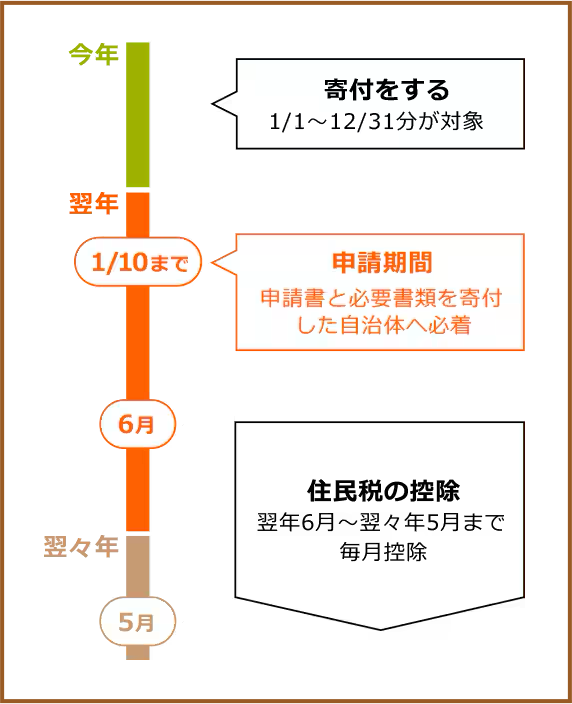
The application deadline for the One-Stop Special Exception System is January 10 of the following year after the donation was made.
For donations made between January 1 and December 31 of the current year, prepare an application form and required documents for each donation and send them to the municipality by the deadline.
If you miss the deadline, you must file a tax return to claim the deduction.
Process for Using the One-Stop Special Exception System
STEP 1
Gather the required documents
To use the One-Stop Special Exception System, first gather the following documents.
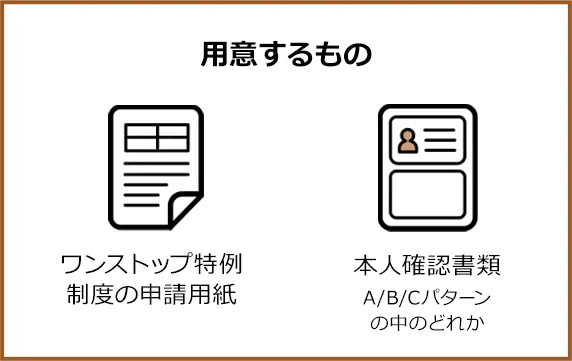
It is essential to send a completed One-Stop Special Application Form (Application for Special Deduction for Donations) to each municipality you donated to.
While municipalities often mail these forms, they can also be obtained from the respective municipality's or the Ministry of Internal Affairs and Communications' websites.
How to Obtain the One-Stop Special Application Form
The form can be obtained in the following ways.
If you prefer to prepare your own form, you can download a blank form, print it, and fill in the required information before submission.
Identification documents
Attach copies of both your My Number and an identity verification document.
Please prepare the documents using one of the following methods:
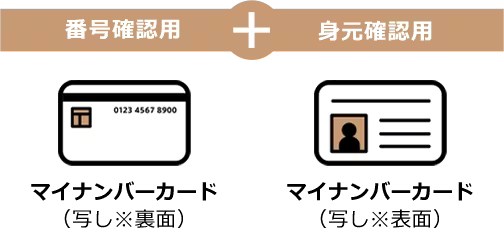
Option A
- Both sides of the My Number card (copy)
Option B
- Notification card or resident record (copy with My Number)
- Driver's license or passport (copy)
Option C
- Notification card or resident record (copy with My Number)
- Two or more copies of official documents recognized by the municipality, such as health insurance card and pension book
Note: Cover health insurance numbers, policyholder symbols, and numbers, as well as QR codes with a post-it or similar item before copying if displayed on the insurance card.
STEP 2
Complete the application form
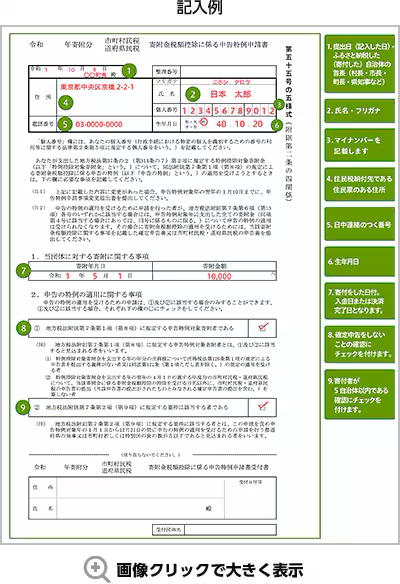
Fill out the necessary information on the One-Stop Special Application Form (Application for Special Deduction for Donations).
Refer to the sample form for guidance.
STEP 3
Mail the documents to each municipality by the deadline
Mail the documents prepared in STEP1 and STEP2 to each municipality where a donation was made.
The application deadline is January 10 of the following year (must arrive by this date).
Ensure the documents arrive without any errors by the deadline.
Pre-submission Checklist
Option A: Both sides of the My Number card (copy)
Option B: Notification card or resident record (with My Number) + Driver's license or passport (copy)
Option C: Notification card or resident record (with My Number) + two official documents, such as health insurance card, pension book
Note: If you made multiple donations to the same municipality, you must submit an application and identification document for each donation.
Difference Between the One-Stop Special Exception System and Tax Return
In addition to the One-Stop Special Exception System, you may also claim deductions for Hometown Tax donations through a standard tax return.
Here is an overview of the key differences.
| When Filing a Tax Return | When Using the One-Stop Special Exception System | |
|---|---|---|
| Eligible Taxes | Income tax and residential tax | Residential tax only (income tax portion is also deducted from residential tax) |
| Example Deduction | For a donation of 10,000 JPY | For a donation of 10,000 JPY |
| Self-payment: 2,000 JPY | Self-payment: 2,000 JPY | |
| Deducted from income: 800 JPY | Deducted from income: 0 JPY | |
| Deducted from residential tax: 7,200 JPY | Deducted from residential tax: 8,000 JPY | |
| Municipalities Count | More than 5 municipalities allowed | Up to 5 municipalities |
| Application Deadline | February 16 to March 15 of the following year | January 10 of the following year |
Eligible Taxes and Deduction Amounts
- Tax deductions vary by method. A tax return allows deductions from both income and residential taxes, whereas the One-Stop Special Exception System only applies to residential tax.
- For deductions near the maximum limit, both methods yield nearly identical results in deduction amounts.
Housing loan deduction
The deduction amount is usually the same whether you use the One-Stop Special Exception System or file a tax return. A housing loan deduction is the exception, because it applies to income tax.
If you claim the hometown tax donation on a tax return, the income-tax portion of that donation deduction can reduce the housing loan deduction. The One-Stop Special Exception System deducts the donation from resident tax only, so it does not reduce the housing loan deduction.
The first year of a housing loan deduction requires a tax return, so you cannot use the One-Stop Special Exception System in that year. From the second year, year-end adjustment handles the housing loan deduction, and you can use the One-Stop Special Exception System if you meet its other conditions.
Cautions for the one-stop special exception system
A few limits are easy to miss after you send the application.
Filing a tax return voids the one-stop application
If you file a tax return, the one-stop application does not apply, including applications you already submitted. Claim the hometown tax donation on the tax return.
A medical expense deduction is one case that requires a tax return. When you claim that deduction, the one-stop resident-tax deduction no longer applies, so claim the donation deduction on the same tax return.
Send the application form by the deadline
The application form (寄附金税額控除に係る申告特例申請書) has to arrive at each municipality by January 10 of the year after the donation. If it misses that date, file a tax return instead. The tax-return window, February 16 to March 15 of the following year, is later, so prepare the one-stop documents before the end of the donation year.
Prepare one application for each donation
The one-stop system covers at most five municipalities. Donations to the same municipality count as one municipality, and each donation still needs its own application. One donation requires one application form.
The deduction applies to resident tax only
The one-stop deduction comes out of resident tax. The total is usually the same as filing a tax return, because the income-tax portion is included in the resident-tax deduction. There is no separate income-tax refund.
Submit a change notice if your details change
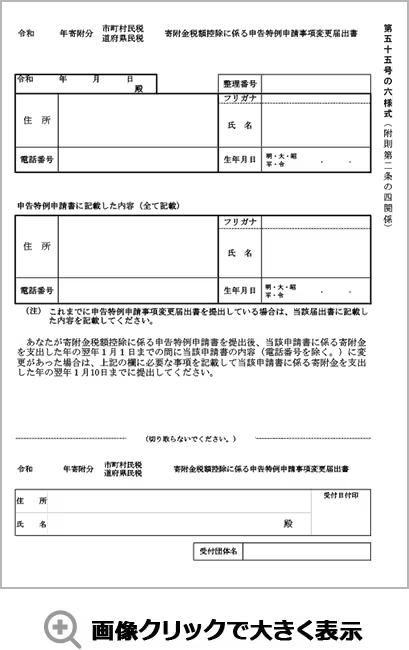
If you already submitted the application, and any detail other than your phone number changes on or before January 1 of the year after the donation, submit a change notice (申請事項変更届出書). The notice has to arrive by January 10 of that year at each municipality you donated to. Include copies of documents that show the new name or address.
FAQ for the One-Stop Special Exception System
When can I apply?
You can apply from the donation date onward. No proof of deduction or donation receipt is required for this application.What if the documents are incorrect or late?
Applications with errors or late submissions will not be accepted. In such cases, please file a tax return.When will I receive the application form?
Some municipalities do not mail the form. In that case, download the form for submission.What if I want to file a tax return after I apply?
You can file a tax return after you send the one-stop application. If you do both, the tax return takes priority, and every one-stop application for that year is void. Include those donations on the tax return.